Choosing an AI-Powered CRM for a Small Agency: A Buyer's Checklist
Every CRM now claims AI features. For a small agency, only a few of them save real time. Here is how to tell the difference and run a trial that answers the question quickly.
By SaaSVisionary Team · · 6 min read
Five years ago, “AI CRM” meant an enterprise product with a six-month implementation. Today nearly every CRM on the market has an AI button somewhere, from email drafting to call summaries. For a small agency, the question is no longer whether AI is available. It is which features will actually give your team hours back, and which are demos that look great and get used once.
Small agencies have a specific set of constraints: few people wearing many hats, a mix of your own sales pipeline and client work, and little time to configure complex tools. A good AI-powered CRM should fit those constraints, not add to them.
This guide breaks AI features into what tends to matter for agencies of two to twenty people, suggests questions to ask vendors, and lays out a two-week trial plan.
What “AI-powered” usually means in a CRM
Most AI features in today’s CRMs fall into five groups:
- Writing help. Drafting emails, texts, and replies from context.
- Summaries. Condensing calls, email threads, and meeting notes.
- Prioritization. Scoring leads or flagging deals at risk.
- Conversational agents. AI that answers calls, chats, or texts on your behalf.
- Assistants that take actions. AI that can update records, create tasks, or run workflows when asked.
Each can be useful. The value depends on how much of your team’s week goes to the work it replaces.
Features that tend to pay off for small agencies
Call and meeting summaries
If your team spends time on client and prospect calls, automatic transcripts and summaries remove a surprising amount of note-taking. They also make handoffs easier: the account manager can read what the salesperson heard. On SaaSVisionary, call transcription is included from the Team plan, and call intelligence surfaces patterns across calls.
AI phone and chat agents
Missed calls and after-hours inquiries are a quiet leak for many agencies and for the local businesses they serve. An AI receptionist can answer, qualify, and book, then log everything to the contact record. On SaaSVisionary, the Team plan includes one AI phone agent and the Unlimited plan includes unlimited agents.
Drafting with real context
AI writing helps most when it can see the client record: goals, recent conversations, and deal stage. A generic writing assistant bolted onto a CRM saves less time than one that pulls from the history your team already built.
Simple lead prioritization
Lead scoring does not have to be sophisticated to help. Even basic signals, like which pages someone viewed, whether they opened your proposal, and their company size, help a busy owner decide who to call first.
Features that often disappoint small teams
Be skeptical of these, not because they cannot work, but because they need conditions small agencies rarely have:
- Predictive forecasting usually needs a lot of historical deal data before it is reliable.
- Complex AI scoring models may be hard to explain, and if your team does not trust the score, they will ignore it.
- “Fully autonomous” sales agents that email prospects without review can damage your reputation quickly.
- AI features priced as separate add-ons can double the real cost of a tool. Check what is included in the plan you are considering.
Questions to ask any vendor
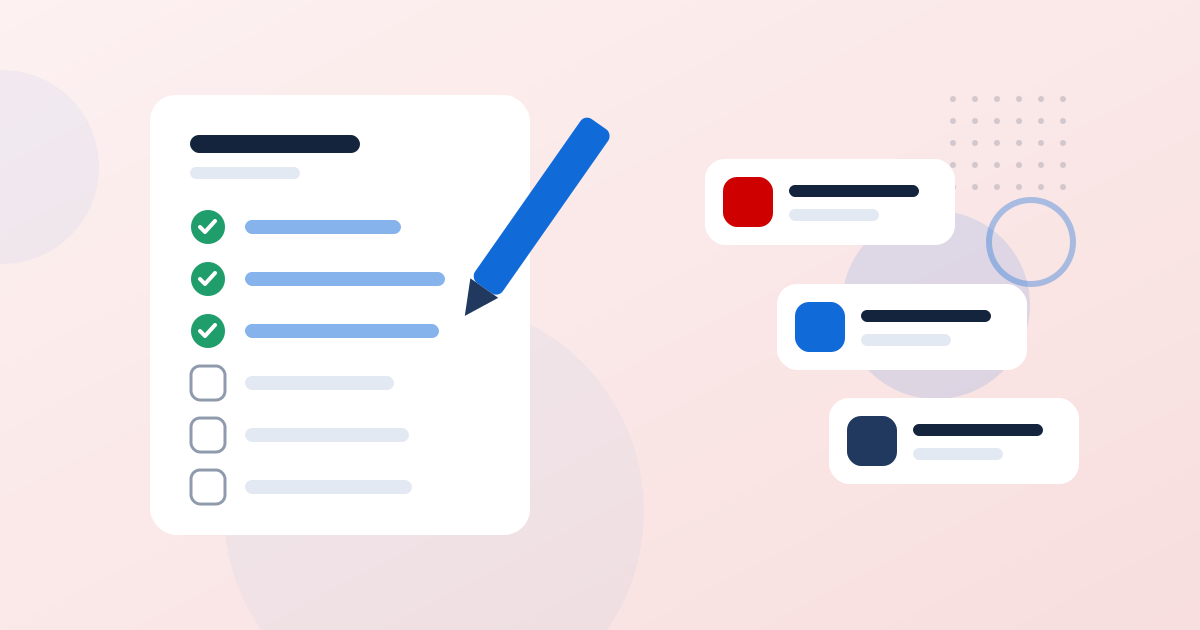
Use this checklist in demos and trials:
| Question | Why it matters |
|---|---|
| Which AI features are included in the plan I’d buy? | Avoid surprise add-on costs |
| Whose AI model runs it, and how is usage billed? | Some platforms use your own model key, others bundle usage |
| Can AI see my CRM data, and what is retained? | Privacy and client confidentiality |
| Can I review AI-drafted messages before they send? | Protects client relationships |
| Does AI connect to workflows and tasks? | AI that cannot act is just a text box |
| Is there an API or MCP access for other tools? | Future flexibility |
| Is phone, SMS, and email built in or separate? | Fewer tools, fewer integrations |
For reference, SaaSVisionary has customers connect their own AI-model, Twilio, and Mailgun keys, so provider usage is billed by those providers. The REST API is on the Team plan and above, and the MCP server is on Unlimited.
A two-week trial plan
Most CRMs offer a free trial. Use it to test real work, not to click through menus. Here is a plan an invented agency, Fieldnote Marketing, a three-person shop in Boise, used.
Days 1 to 3: Import and structure
- Import current leads and clients.
- Set up one sales pipeline and one client-delivery pipeline.
- Add three or four custom fields you actually use, such as client goal and renewal date.
Days 4 to 7: Test one AI feature on live work
- Pick the feature most likely to save time. For Fieldnote, that was call summaries.
- Use it on every call for four days.
- Note how often the summary was accurate enough to skip manual notes.
Days 8 to 11: Connect AI to a workflow
- Build one automation that uses AI output, such as a follow-up email drafted from call notes that lands in a review queue.
- Measure how long review takes compared to writing from scratch.
Days 12 to 14: Decide
- Add up the hours saved during the trial and project them over a month.
- List anything that blocked real work.
- Compare against plan cost, including any AI usage fees.
Every SaaSVisionary plan includes a 14-day free trial, which fits this plan neatly. See the pricing page for what each plan includes.
Adoption matters more than features
The best CRM is the one your team actually uses. A few habits help:
- Choose one owner for the CRM who sets conventions and answers questions.
- Retire old tools on a set date so data does not stay split.
- Start with a few automations and add more once the basics are trusted.
- Review AI output weekly during the first month to catch errors early.
If your team likes building on top of tools, look for flexibility such as custom fields and objects in a custom CRM. If they prefer something ready-made, favor strong defaults over endless options.
Frequently asked questions
Is an AI-powered CRM worth it for a very small agency?
It can be, if the AI features replace real hours of work. For many small agencies, call summaries, AI-answered calls, and drafted follow-ups save the most time. Run a trial on actual client and sales work, measure the time saved, and compare it against the plan cost, including any AI usage fees.
What AI CRM feature should a small agency try first?
Pick the task that eats the most time today. If your team is on the phone a lot, try call transcription and summaries. If calls go unanswered, try an AI phone agent. If writing follow-ups is the bottleneck, try AI drafting connected to your CRM records. One focused test teaches more than enabling everything.
Do AI CRMs replace account managers or salespeople?
No. They take over repetitive work like note-taking, first drafts, and routine inquiries, so people can spend more time on relationships and strategy. Keep humans in charge of client decisions, sensitive conversations, and approving messages to important accounts. AI works best as an assistant, not a replacement.
How is AI usage billed in a CRM?
It varies. Some CRMs bundle AI usage into the subscription or sell it as an add-on, while others let you connect your own AI-model key and pay the model provider directly. Ask vendors how usage is measured and billed so you can estimate the real monthly cost.
Want to test an AI CRM on your own agency’s work? Start a free 14-day trial.